Urban Craftsmen and Traders in the Roman World
Edited by Andrew Wilson and Miko Flohr
Oxford Studies on the Roman Economy, Oxford University Press, 2016.
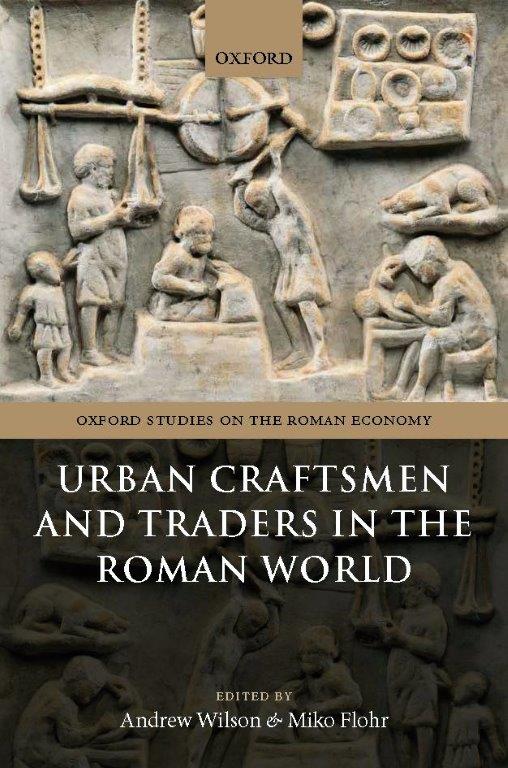
This volume, featuring sixteen contributions from leading Roman historians and archaeologists, sheds new light on approaches to the economic history of urban craftsmen and traders in the Roman world, with a particular emphasis on the imperial period. Combining a wide range of research traditions from all over Europe and utilizing evidence from Italy, the western provinces, and the Greek-speaking east, this edited collection is divided into four sections. It first considers the scholarly history of Roman crafts and trade in the nineteenth and twentieth centuries, focusing on Germany and the Anglo-Saxon world, and on Italy and France. Chapters discuss how scholarly thinking about Roman craftsmen and traders was influenced by historical and intellectual developments in the modern world, and how different (national) research traditions followed different trajectories throughout the nineteenth and twentieth centuries. The second section highlights the economic strategies of craftsmen and traders, examining strategies of long-distance traders and the phenomenon of specialization, and presenting case studies of leather-working and bread-baking. In the third section, the human factor in urban crafts and trade-including the role of apprenticeship, gender, freedmen, and professional associations-is analysed, and the volume ends by exploring the position of crafts in urban space, considering the evidence for artisanal clustering in the archaeological and papyrological record, and providing case studies of the development of commercial landscapes at Aquincum on the Danube and at Sagalassos in Pisidia.
For more information, and to order, visit the Oxford University Press website.
Introduction
Part I: Approaches
1: Roman Craftsmen and Traders: Towards an Intellectual HistoryMiko Flohr and Andrew Wilson
2: Twentieth Century Italian Research on Craftsmen, Traders, and their Professional Organizations in the Roman WorldCarla Salvaterra and Alessandro Cristofori
3: The Archaeology of Ancient Urban Workshops: A French Approach?Jean-Pierre Brun
Part II: Strategies
4: Mercantile Specialization and Trading Communities: Economic Strategies in Roman Maritime Trade Candace Rice 5: Driving Forces for Specialization: Market, Location Factors, Productivity Improvements Kai Ruffing 6: Fashionable Footwear: Craftsmen and Consumers in the North-West Provinces of the Roman Empire Carol van Driel-Murray 7: Contextualizing the Operational Sequence: Pompeian Bakeries as a Case Study Nicolas MonteixPart III: People
8: Disciplina, patrocinium, nomen: The Benefits of Apprenticeship in the Roman WorldChristel Freu
9: Women, Trade, and Production in the Urban Centres of Roman ItalyLena Larsson Lovén
10: Freedmen and Agency in Roman BusinessWim Broekaert
11: The Social Organization of Commerce and Crafts in Ancient Arles: Heterogeneity, Hierarchy, and PatronageNicolas Tran
12: Hierapolis and its Professional Associations: A Comparative AnalysisIlias Arnaoutoglou
Part IV: Space
13: Working Together: Clusters of Artisans in the Roman CityPenelope Goodman
14: Spatial Concentration and Dispersal of Roman Textile CraftsKerstin Dross-Krüpe
15: Industry and Commerce in the City of AquincumOrsolya Láng
16: The Potters of Ancient Sagalassos RevisitedJeroen Poblome