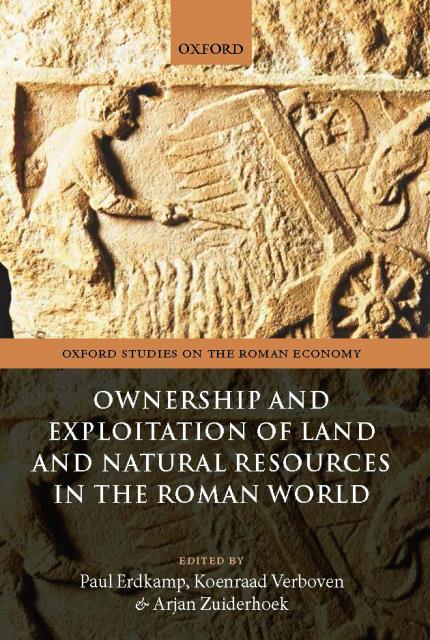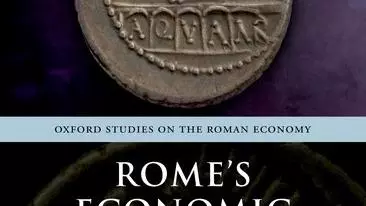
Ownership and Exploitation of Land and Natural Resources in the Roman World
Edited by Paul Erdkamp, Koenraad Verboven, and Arjan Zuiderhoek
Oxford Studies on the Roman Economy, Oxford University Press, 2015.
Explanation of the success and failure of the Roman economy is one of the most important problems in economic history. As an economic system capable of sustaining high production and consumption levels, it was unparalleled until the early modern period.
This volume focuses on how the institutional structure of the Roman Empire affected economic performance both positively and negatively. An international range of contributors offers a variety of approaches that together enhance our understanding of how different ownership rights and various modes of organization and exploitation facilitated or prevented the use of land and natural resources in the production process.
Relying on a large array of resources - literary, legal, epigraphic, papyrological, numismatic, and archaeological - chapters address key questions regarding the foundations of the Roman Empire's economic system. Questions of growth, concentration and legal status of property (private, public, or imperial), the role of the state, content and limitations of rights of ownership, water rights and management, exploitation of indigenous populations, and many more receive new and original analyses that make this book a significant step forward to understanding what made the economic achievements of the Roman empire possible.
For more information, and to order, see the OUP Catalogue.
1: Introduction: Land and Natural Resources in the Roman World in Historiographical and Theoretical Perspective
Arjan Zuiderhoek
2: Agriculture, Division of Labour, and the Paths to Economic GrowthPaul Erdkamp
Part I: Ownership and Control
3: Landed Wealth in the Long Term: Patterns, Possibilities, EvidenceKyle Harper
4: The Development of Imperial PropertyElio Lo Cascio
5: Imperial Wealth in Roman Egypt: The Julio-Claudian ousiaiLaurens Tacoma
6: Property Rights over Land and Economic Growth in the Roman EmpireDennis Kehoe
7: Ownership and Control: Property Rights and Insitutional ArrangementsÉva Jakab
8: Water Use and Productivity in Roman Agriculture: Selling, Sharing, ServitudesChrister Bruun
9: Control and Management of Water in Ostrogothic ItalyYuri A. Marano
Part II: Organization and Modes of Exploitation
10: The Nature of the Villa EconomyAlessandro Launaro
11: The Variety of Villa Production: From Agriculture to AquacultureAnnalisa Marzano
12: The African Boom: The Origins of Economic Growth in Roman North AfricaMatthew S. Hobson
13: The Local Economy of Palmyra: Organizing Agriculture in an Oasis EnvironmentJulia Hoffmann-Salz
14: Changes in Animal Husbandry as a Consequence of Changing Social and Economic Patterns: Zooarchaeological Evidence from the Roman Mediterranean ContextMichael MacKinnon
Part III: Exploitation and Processing
15: Salt in Asia Minor: An Outline of Roman Authority Interest in the ResourceIsabella Tsigarida
16: Imperial Quarries and the EmperorAlfred M. Hirt
17: The Mining, Minting, and Obtaining of Gold in the Roman EmpireFernando López Sánchez
Conclusions